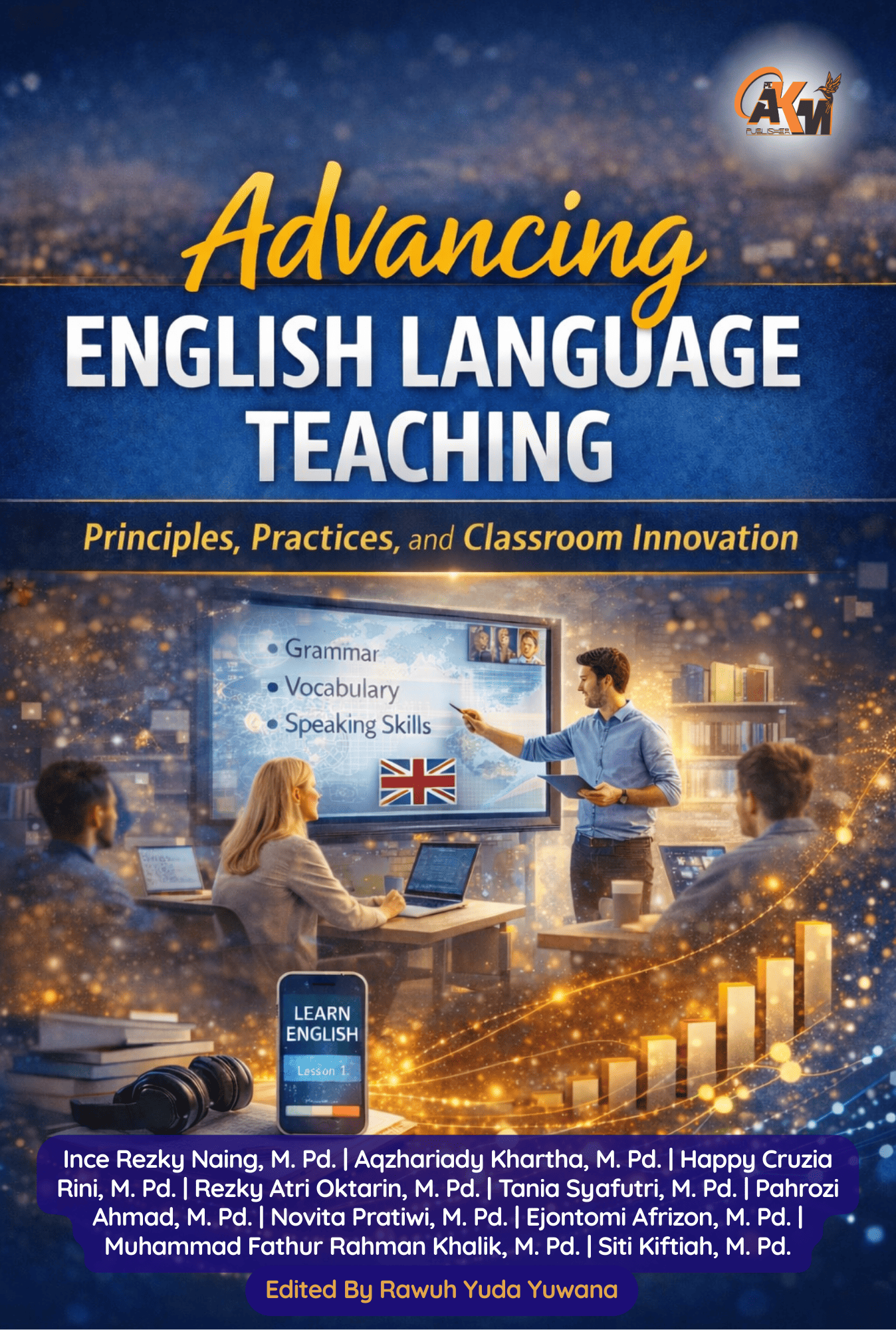
Advancing English Language Teaching Principles, Practices, and Classroom Innovation
Kata Kunci:
Advancing English Language Teaching Principles, Practices, and Classroom InnovationAbstrak
Advancing English Language Teaching: Principles, Practices, and Classroom Innovation offers a comprehensive overview of contemporary English language teaching in a globalized educational era. The book connects theoretical foundations with practical classroom strategies for educators, pre-service teachers, and researchers. It discusses modern pedagogical principles, language learning theories, lesson design, and effective teaching of listening, speaking, reading, and writing. It also explores contextual vocabulary and grammar instruction, innovative approaches such as task-based and project-based learning, and digital pedagogy integration. Additionally, the book highlights professional development and future ELT directions, supporting teachers in creating adaptive, inclusive, and technology-enhanced learning environments for diverse learners across varied global and local educational contexts worldwide today.
Referensi
Acar, S. E., & Erozan, F. (2024). Understanding English language teachers’ (de)motivation toward continuing professional development through psychological contract and work attitude. SAGE Open, 14(2). https://doi.org/10.1177/21582440241242555
Afflerbach, P., Pearson, P. D., & Paris, S. G. (2008). Clarifying differences between reading skills and reading strategies. The Reading Teacher, 61(5), 364–373.
https://doi.org/10.1598/RT.61.5.1
Almashour, M. (2024). Bridging worlds with words: Translanguaging and its impact on identity formation among Jordanian graduate students in Ontario. Frontiers in Education, 9, Article 1464741. https://doi.org/10.3389/feduc.2024.1464741
Almegren, A., Almegren, R. M., Hazaea, A. N., Mahdi, H. S., & Mohammed Ali, J. K. (2025a). AI powered ELT: Instructors’ transformative roles and opportunities. PLoS One, 20(5), e0324910.
Anderson, J. (2024). Translanguaging: A paradigm shift for ELT theory and practice. ELT Journal, 78(1), 72–81.
Asril, Zainal. (2010). Microteaching (3rd ed.). Rajawali Pers
Azahra, M., & Abdulrahman, T. (2025). The challenges and best practices of English language teaching in secondary schools: A systematic literature review. Research and Innovation in Applied Linguistics, 9(1), 82–95.
Bahrani, T., Sim, T. S., & Nekoueizadeh, M. (2014). Second language acquisition in informal setting. Theory and Practice in Language Studies, 4(8). https://doi.org/10.4304/tpls.4.8.1714-1723
Baidawi, A. (2016). Using Visual Media in Teaching Speaking. Okara: Journal of Languages and Literature, 10(1), 54–65.
Baser, D., Kopcha, T. J., & Ozden, M. Y. (2016). Developing a technological pedagogical content knowledge (TPACK) assessment for preservice teachers learning to teach English as a foreign language. Computer Assisted Language Learning, 29(4), 749–764. https://doi.org/10.1080/09588221.2015.1047456
Bećirović, S. (2023). Digital pedagogy: The use of digital technologies in contemporary education. Springer Nature Singapore. https://doi.org/10.1007/978-981-99-0444-0
Bedir, H. (2019). Pre-service ELT teachers’ beliefs and perceptions on 21st century learning and innovation skills (4Cs). Journal of Language and Linguistic Studies, 15(1), 231–246.
Bell, S. (2010). Project-based learning for the 21st century: Skills for the future. The Clearing House: A Journal of Educational Strategies, Issues and Ideas, 83(2), 39–43. https://doi.org/10.1080/00098650903505415
Black, P., & Wiliam, D. (1998). Assessment and classroom learning. Assessment in Education: Principles, Policy & Practice, 5(1), 7–74.
Block, D. (2010). Globalization and language teaching. The Handbook of Language and Globalization, 287–304.
Blumenfeld, P. C., Soloway, E., Marx, R. W., Krajcik, J. S., Guzdial, M., & Palincsar, A. (1991). Motivating project-based learning: Sustaining the doing, supporting the learning. Educational Psychologist, 26(3–4), 369–398. https://doi.org/10.1080/00461520.1991.9653139
Blundell, C. N., Mukherjee, M., & Nykvist, S. (2022). A scoping review of the application of the SAMR model in research. Computers and Education Open, 3, 100093. https://doi.org/10.1016/j.caeo.2022.100093
Bostancıoğlu, A., & Handley, Z. (2018). Developing and validating a questionnaire for evaluating the EFL ‘Total PACKage’: Technological pedagogical content knowledge (TPACK) for English as a foreign language (EFL). Computer Assisted Language Learning, 31(5–6), 572–598. https://doi.org/10.1080/09588221.2017.1422524
Boud, D., & Lee, A. (Eds.). (2009). Changing practices of doctoral education (pp. 8-1). London: Routledge.
British Council. (2024). Artificial Intelligence and English language teaching: Preparing for the future. British Council Publishing.
Brown, H. D. (2001). Teaching by principles: An interactive approach to language pedagogy (2nd ed.). Longman.
Brown, H. D. (2004). Language assessment: Principles and classroom practices. Longman.
Brown, H. D. (2007). Principles of language learning and teaching (5th ed.). Pearson Education.
Brown, H. D. (2007). Teaching by principles: An interactive approach to language pedagogy (3rd ed.). Pearson Education.
Brown, H. D. (2014). Teaching by principles: An interactive approach to language pedagogy (4th ed.). Longman.
Brown, H. D. (2015). Teaching by principles: An interactive approach to language pedagogy (4th ed.). Pearson Education.
Brown, H. D., & Abeywickrama, P. (2010). Language assessment: Principles and classroom practices (2nd ed.). Pearson Education.
Bruffee, K. A. (1995). Collaborative learning: Higher education, interdependence, and the authority of knowledge. Johns Hopkins University Press.
Bruner, J. S. (1966). Toward a theory of instruction. Harvard University Press.
Budiman, R. A., Pertiwi, S. A., & Yuwana, R. Y. (2025). Sintaksis dan Gramatika Bahasa Inggris. PT Akselerasi Karya Mandiri, 173.
Burns, A., & Richards, J. C. (2018). The Cambridge guide to learning English as a second language. Cambridge University Press.
Bygate, M. (2015). Domains and directions in the development of speaking. In D. Nunan & J. C. Richards (Eds.), Language learning beyond the classroom (pp. 45–58). Routledge.
Bygate, M., Skehan, P., & Swain, M. (Eds.). (2001). Researching pedagogic tasks: Second language learning, teaching and testing. Pearson Education.
Canton, U., Govan, M., & Zahn, D. (2018). Rethinking academic literacies. A conceptual development based on teaching practice. Teaching in higher education, 23(6), 668-684. http://doi.org/10.1080/13562517.2017.1414783
Castillo-Cuesta, L. (2020). Using digital games for enhancing EFL grammar and vocabulary in higher education. International Journal of Emerging Technologies in Learning (iJET), 15(20), 116–129.
Çebi, A. (2018). Teachers’ perceptions toward technology integration into the language teaching practices. Journal of Narrative and Language Studies, 6(11), 150–177.
Celce-Murcia, M., & Larsen-Freeman, D. (2015). The grammar book: Form, meaning, and use for English language teachers (3rd ed.). National Geographic Learning.
Chapelle, C. A. (2016). Teaching culture in introductory foreign language textbooks. Palgrave Macmillan.
Cirocki, A., & Hallet, W. (2024). Building professional English language teaching development communities. In Professionalising English language teaching: Concepts and reflections for action in teacher education (pp. 208–236). Cambridge University Press.
Code, J. (2020). Agency for learning: Intention, motivation, self-efficacy and self-regulation. Frontiers in Education, 5, 1–15.
Conklin, K., & Carrol, G. (2021). Words go together like ‘bread and butter’: The rapid, automatic acquisition of lexical patterns. Applied Linguistics, 42(3), 492-513.
Correa, M. (2015). Flipping the foreign language classroom and critical pedagogies. Higher Education for the Future, 2(2), 114–125.
Croxall, B. (2012). “Digital pedagogy”? A Digital Pedagogy Unconference. https://www.briancroxall.net/digitalpedagogy/what-is-digital-pedagogy/
Crystal, D. (2003). English as a global language. Cambridge university press.
Curran, R. (2014). Students As Partners: An Exploration of Process to Effect Transformational Change. ICED 2014 Educational Development in a Changing World, 119.
Darling-Hammond, L. (2020). Culture, learning, and policy. In Handbook of the cultural foundations of learning (pp. 404–426). Routledge.
DeKeyser, R. (2020). Skill acquisition theory. In Theories in second language acquisition (pp. 83-104). Routledge.
Dewi, U., Fithriani, R., & Berutu, H. (2024). Indonesian EFL teachers’ professional development: Views and current practices. Indonesian Research Journal in Education, 8(2), 589–607. https://doi.org/10.22437/irje.v8i2.39425
Dillenbourg, P. (1999). What do you mean by collaborative learning? In P. Dillenbourg (Ed.), Collaborative learning: Cognitive and computational approaches (pp. 1–19). Elsevier.
Division, C. of Europe. C. for C. C. E. Committee. M. L. (2001). Common European framework of reference for languages: Learning, teaching, assessment. Cambridge University Press.
Dörnyei, Z. (2001). Motivational strategies in the language classroom. Cambridge University Press.
East, M. (2017). Task-based language teaching: From theory to implementation. Language Teaching, 50(4), 498–506. https://doi.org/10.1017/S0261444817000192
Ellis, R. (2003). Task-based language learning and teaching. Oxford University Press.
Ellis, R. (2005). Principles of instructed language learning. System, 33(2), 209-224.
Ellis, R. (2015). Understanding second language acquisition 2nd edition. Oxford university press.
Ellis, R. (2017). Position paper: Moving task-based language teaching forward. Language Teaching, 50(4), 507–526. https://doi.org/10.1017/S0261444817000179
Ellis, R. (2017). Task-based language teaching. Oxford University Press.
Ellis, R. (2020). Task-based language teaching for beginner-level young learners. Language Teaching for Young Learners, 2(1), 4-27.
Enny, F., Mannan, M., & Maruf, T. I. (2025). The impact of globalization on intercultural communication and education: A qualitative study. ABC Journal of Advanced Research, 14(1), 1–14. https://doi.org/10.18034/abcjar.v14i1.793
Evertson, C. M., & Weinstein, C. S. (2006). Handbook of classroom management: Research, practice, and contemporary issues. Lawrence Erlbaum Associates.
Fahl, J., Duvivier, R., Reinke, L., Pierie, J., & Schönrock-Adema, J. (2023). Towards best practice in developing motor skills: a systematic review on spacing in VR simulator-based psychomotor training for surgical novices. BMC Medical Education, 23. https://doi.org/10.1186/s12909-023-04046-1.
Farrell, T. S. (2015). Second language teacher education: A reality check. In International perspectives on English language teacher education: Innovations from the field (pp. 1-15). London: Palgrave Macmillan UK.
Fithriyani, H. Y., & Fauzi, A. Z. (2024). Enhancing students’ speaking skill through drill and practice method. International Journal of Studies in International Education, 1(3), 29–40. https://doi.org/10.62951/ijsie.v1i3.38
Flowerdew, J. (2022). Corpora in language education (2nd ed.). Palgrave Macmillan.
Flynn, N., & Stainthorp, R. (2006). The Learning and Teaching of Reading and Writing. Wiley-Blackwell.
Fotos, S. (2002). Structure-based interactive tasks for the EFL grammar learner. In E. Hinkel & S. Fotos (Eds.), New perspectives on grammar teaching in second language classrooms (pp. 135–154). Lawrence Erlbaum Associates.
Fu, M., & Li, S. (2020). THE EFFECTS OF IMMEDIATE AND DELAYED CORRECTIVE FEEDBACK ON L2 DEVELOPMENT. Studies in Second Language Acquisition, 44, 2 - 34. https://doi.org/10.1017/s0272263120000388.
Fulcher, G. (2024). Practical language testing. Routledge.
Ghazi-Saidi, L., & Ansaldo, A. I. (2017). Second language word learning through repetition and imitation: Functional networks as a function of learning phase and language distance. Frontiers in Human Neuroscience, 11, Article 463. https://doi.org/10.3389/fnhum.2017.00463
Gibbons, P. (2015). Scaffolding language, scaffolding learning: Teaching English language learners in the mainstream classroom (2nd ed). Heinemann.
Gilmore, A. (2007). Authentic materials and authenticity in foreign language learning. Language Teaching, 40(2), 97–118. https://doi.org/10.1017/S0261444807004144
Godwin-Jones, R. (2025). Technologies Integration for Less Commonly Taught Languages: AI and Pedagogical Translanguaging. Language Learning & Technology, 29(2), 11-34.
Goh, C. C. M., & Burns, A. (2012). Teaching speaking: A holistic approach. Cambridge University Press.
Golubovschi, O. (2024). Interactive Strategies for Teaching English: Enhancing Language Acquisition through Communicative and Task-Based Learning. In Higher education: traditions, values, perspectives (pp. 240-244).
Grabe, W. (2009). Teaching and testing reading. In M. H. Long & C. J. Doughty (Eds.), The handbook of language teaching (pp. 441–462). Wiley-Blackwell.
https://doi.org/10.1002/9781444315783.ch25
Grabe, W., & Stoller, F. L. (2019). Teaching and researching reading (3rd ed.). Routledge.
Grabe, W., & Zhang, C. (2016). Reading-writing relationships in first and second language academic literacy development. Language Teaching, 49(3), 339–355. https://doi.org/10.1017/S0261444816000082
Graham, C. R. (2018). Current research in blended learning. Handbook of Distance Education, 173–188.
Gusnetti, & Naini, I. (2025). Interrogative listening ability of students of the 2024/2025 class of Indonesian Language and Literature Education Study Program FKIP Bung Hatta University. Kolokium: Jurnal Pendidikan Luar Sekolah, 13(1), 41–48. https://doi.org/10.24036/kolokium.v13i1.1046
Halid, L. I. (2024). Constructivist approach to language learning: Linking Piaget’s theory to modern educational practice. INTERACTION: Jurnal Pendidikan Bahasa, 11(2), 306–327. https://doi.org/10.36232/interactionjournal.v11i2.33
Halliday, M. A. K. (1978). Language as social semiotic: The social interpretation of language and meaning. Edward Arnold.
Hamilton, E. R., Rosenberg, J. M., & Akcaoglu, M. (2016). The substitution augmentation modification redefinition (SAMR) model: A critical review and suggestions for its use. TechTrends, 60(5), 433–441. https://doi.org/10.1007/s11528-016-0091-y
Harmer, J. (2007). How to teach English. Longman.
Harmer, J. (2015). How to teach English (new ed.). Longman.
Hastensi, W. (2020). Penerapan metode pembelajaran drill and practice untuk meningkatkan kemampuan speaking dan vocabulary. DIADIK: Jurnal Ilmiah Teknologi Pendidikan, 10(2), 68–77.
Herdiana, & Munir, S. (2023). The effect of teacher scaffolding and peer-scaffolding on reading comprehension and vocabulary ability. Jurnal Pendidikan Indonesia, 12(3), 451–460. https://doi.org/10.23887/jpiundiksha.v12i3.61213
Hidayati, L., Widiati, U., & Irawati, E. (2020). The Challenges Faced by Graduates of Teacher Professional Education Program. Jurnal Pendidikan: Teori, Penelitian, dan Pengembangan, 5(12), 1754—1767.
Hockly, N. (2012). Digital literacies. ELT Journal, 66(1), 108-112.
Hockly, N. (2016). Focus on learning technologies. Oxford University Press.
Howard, S. K., Tondeur, J., Siddiq, F., & Scherer, R. (2021). Ready, set, go! Profiling teachers’ readiness for online teaching in secondary education. Technology, Pedagogy and Education, 30(1), 141–158.
Howell, J. (2012). Teaching with ICT: Digital pedagogies for collaboration and creativity. Oxford University Press.
Howell, J., & McMaster, N. (2022). Teaching with technologies: Digital pedagogies for collaboration and creativity (2nd ed). Oxford University Press.
Humayrah, U., Siregar, D., Hajmi, M., Nasution, M., Hsb, J., Fadillah, F., & Ridwan, A. (2024). THE ROLE OF PRAGMATIC AWARENESS IN EFL UNIVERSITY STUDENTS' COMMUNICATION SKILLS. VISION. https://doi.org/10.30829/vis.v20i2.3954.
Hunter, K., & Tse, H. (2013). Making disciplinary writing and thinking practices an integral part of academic content teaching. Active Learning in Higher Education, 14(3), 227-239. https://doi.org/10.1177/1469787413498037
Hyland, K. (2019). Second language writing (2nd ed.). Cambridge University Press.
Ibrahim, A., Rezaee, A., & Azizi, Z. (2012). The role of zone of proximal development in students’ learning of English adverbs. Journal of Language Teaching and Research, 3(1), 51–57. https://doi.org/10.4304/jltr.3.1.51-57
Indriani, C. L., Muth’im, A., & Febriyanti, E. R. (2024). English language learning through the use of digital technology: A literature review. Linguistic, English Education and Art (LEEA) Journal, 7(2). https://doi.org/10.31539/leea.v7i2.9268283
Jabsheh, A.-A.-H. M. M. (2024). The applicability of the PICRAT, TPACK, and SAMR models to the teaching and learning of English as a foreign language. Journal of Learning and Development Studies, 4(1), 01–08. https://doi.org/10.32996/jlds.2024.4.1.1
Javadi, Y., & Kazemirad, F. (2020). Usage-based Approaches to Second Language Acquisition: Cognitive and Social Aspects. Journal of Language Teaching and Research, 11(3), 473-479.
Jenkins, J., & Panero, S. M. (2024). Global Englishes: A resource book for students. Routledge.
Johnson, A. P. (2008). Teaching Reading and Writing: A Guidebook for Tutoring and Remediating Students. Rowman & Littlefield Education.
Johnson, D. W., & Johnson, R. T. (1999). Learning together and alone: Cooperative, competitive, and individualistic learning (5th ed.). Allyn & Bacon.
Johnson, D. W., Johnson, R. T., & Smith, K. A. (2014). Cooperative learning: Improving university instruction by basing practice on validated theory. Journal on Excellence in College Teaching, 25(3–4), 85–118.
Kennedy, A. (2005). Models of continuing professional development: A framework for analysis. Journal of In-Service Education, 31(2), 235–250.
Khartha, A., & Adisaturrahimi, A. (2024). Teachers’perception on The Impact of English on Indonesian Language and Culture. KLASIKAL: JOURNAL OF EDUCATION, LANGUAGE TEACHING AND SCIENCE, 6(1), 156-164. https://doi.org/10.52208/klasikal.v6i1.1135
Khartha, A., Baa, S., & Korompot, C. A. (2022). Teacher’s Interpersonal Communication and Its Impacts on Students’ motivation in EFL Learning. Klasikal: Journal of Education, Language Teaching and Science, 4(1), 156-169. https://doi.org/10.52208/klasikal.v4i1.137
Khartha, A., Nasir, S. H., Naing, I. R., Bohang, M. B. A., Dakka, L. N., Rini, H. C., & Kiftiah, S. (2025). Fundamentals of English language teaching: A beginner’s guide for educators. PT Akselerasi Karya Mandiri.
Kim, C., Aichler, L., Bridgett, T., Nicolarakis, O., Lacy, S., Sortino, R., Kushalnagar, P., & Pizzie, R. (2025). Language anxiety: understanding past research and new directions with d/Deaf, DeafBlind, and hard of hearing communities. Frontiers in Psychology, 16. https://doi.org/10.3389/fpsyg.2025.1558714.
Kirkpatrick, A. (2010). English as a lingua franca in ASEAN: A multilingual model (Vol. 1). Hong Kong University Press.
Kitani, A. B. M., & Sakil, R. P. (2025). Integrating cultural frameworks in language education: Strategies and implications. International Journal of Research and Innovation in Applied Science (IJRIAS), 10(4), 239–245. https://doi.org/10.51584/IJRIAS.2025.10040018
Koehler, M. J., Mishra, P., & Cain, W. (2013). What is technological pedagogical content knowledge (TPACK)? Journal of Education, 193(3), 13–19.
Koehler, M. J., Mishra, P., Akcaoglu, M., & Rosenberg, J. M. (2013). The Technological Pedagogical Content Knowledge Framework for Teachers and Teacher Educators. ICT Integrated Teacher Mducation Models, November 2020, 1–8. http://cemca.org.in/ckfinder/userfiles/files/ICT teacher education Module 1 Final_May 20.pdf
Koehler, M., & Mishra, P. (2009). What is technological pedagogical content knowledge (TPACK)? Contemporary Issues in Technology and Teacher Education, 9(1), 60–70.
Kohn, K., & Hoffstaedter, P. (2017). Learner agency and non-native speaker identity in pedagogical lingua franca conversations: Insights from intercultural telecollaboration in foreign language education. Computer Assisted Language Learning, 30(5), 351–367. https://doi.org/10.1080/09588221.2017.1304966
Kohnke, L., & Moorhouse, B. L. (2022). Facilitating synchronous online language learning through Zoom. Relc Journal, 53(1), 296–301.
Krajcik, J. S., & Blumenfeld, P. C. (2006). Project-based learning. In R. K. Sawyer (Ed.), The Cambridge handbook of the learning sciences (pp. 317–334). Cambridge University Press.
Krashen, S. D. (1982). Principles and practice in second language acquisition. Pergamon Press.
Krisbiantoro, B., & Ahmad Ashari, I. (2024). Evaluating the SAMR model for enhancing ICT integration in English language teaching at the tertiary level: A systematic literature review. FRASA, 5(2), 108–115. https://doi.org/10.47701/frasa.v5i2.4027
Kumaravadivelu, B. (2003). Beyond methods: Macrostrategies for language teaching. Yale University Press.
Kumaravadivelu, B. (2006). TESOL methods: Changing tracks, challenging trends. TESOL quarterly, 40(1), 59-81.
Kwan, Y. W., & Wong, A. F. L. (2015). Effects of the constructivist learning environment on students’ critical thinking ability: Cognitive and motivational variables as mediators. International Journal of Educational Research, 70, 68–79. https://doi.org/10.1016/j.ijer.2015.02.006
Larmer, J., Mergendoller, J. R., & Boss, S. (2015). Setting the standard for project based learning. ASCD.
Laurillard, D. (2013). Foreword to the second edition. In H. Beetham & R. Sharpe (Eds.), Rethinking Pedagogy for A Digital Age: Designing for 21st Century Learning (2nd ed, pp. xvi–xviii).
Leeder, T. M. (2022). Behaviorism, Skinner, and operant conditioning: Considerations for sport coaching practice. Strategies, 35(3), 27–32. https://doi.org/10.1080/08924562.2022.2052776
Lewis, M. (1993). The lexical approach: The state of ELT and a way forward. Language Teaching Publications.
Li, M. (2025). Identity in Second Language Learning: Theoretical Perspectives and Research Trends with an Emphasis on Chinese as a Second Language. Journal of Literature & Language. https://doi.org/10.71204/jhxdxz72.
Li, P., & Jeong, H. (2020). The social brain of language: Grounding second language learning in social interaction. NPJ Science of Learning, 5, Article 8. https://doi.org/10.1038/s41539-020-0068-7
Liddicoat, A. J., & Scarino, A. (2013). Intercultural language teaching and learning. John Wiley & Sons.
Lillis, T., Harrington, K., Lea, M., & Mitchell, S. (2020). Working with Academic Literacies: Case Studies Towards Transformative Practice. Parlor Press.
Lindemann, S., Ashley, K., Pinard, S., & Jeong, H. (2025). ‘ITA problem’or opportunity? Online global communication training at a US university to increase undergraduate students’ use of collaborative strategies. Applied Linguistics, 46(3), 522-540.
Littlewood, W. (2007). Communicative and task-based language teaching in East Asian classrooms. Language Teaching, 40(3), 243–249.
Littlewood, W. (2014). Communication-oriented language teaching: Where are we now? Where do we go from here? Language Teaching, 47(3), 349–362.
Loewen, S., & Sato, M. (2018). Interaction and instructed second language acquisition. Language Teaching, 51(3), 285–329. https://doi.org/10.1017/S0261444818000125
Long, M. (2014). Second language acquisition and task-based language teaching. John Wiley & Sons.
Long, M. H. (1996). The role of the linguistic environment in second language acquisition. In W. C. Ritchie & T. K. Bhatia (Eds.), Handbook of second language acquisition (pp. 413–468). Academic Press.
Long, M. H. (2015). Second language acquisition and task-based language teaching. Wiley Blackwell.
Long, M. H., & Crookes, G. (1992). Three approaches to task-based syllabus design. TESOL Quarterly, 26(1), 27–56. https://doi.org/10.2307/3587368
Maahs, I.-M., DeCapua, A., & Triulzi, M. (2025). Digital technology and language learning: Insights from teachers of adult migrant learners. ReCALL, 37(2), 283–297. https://doi.org/10.1017/S0958344024000338
Maarif, M., & Bakar, M. (2025). Learning motivation from the perspective of educational psychology: An analysis based on study habits and learning environment. International Journal of Interdisciplinary Research, 1(2), 89–109. https://doi.org/10.71305/ijir.v1i2.281
MacIntyre, P. D., & Gregersen, T. (2012). Emotions that facilitate language learning: The positive-broadening power of the imagination. Studies in Second Language Learning and Teaching, 2(2), 103-135.
Maheshwari, V. K. (2012). Maheshwari, V. K. (2012). Phases of Teaching. Retrieved from educational research resources.
Maheswari, P., Adnyani, N., & Suwastini, N. (2020). Interlanguage Analysis on Indonesian EFL Learners’ Compositions. Lingua Didaktika: Jurnal Bahasa dan Pembelajaran Bahasa. https://doi.org/10.24036/ld.v14i2.108643.
Manchón, R. M., & Matsuda, P. K. (2022). The reading–writing connection in second language writing. Journal of Second Language Writing, 56, 100873.
https://doi.org/10.1016/j.jslw.2022.100873
Mart, Ç. T. (2012). Encouraging young learners to learn English through stories. English Language Teaching, 5(5), 101–106. https://doi.org/10.5539/elt.v5n5p101
Mart, Ç. T. (2017). The role of teachers in teaching English as a foreign language. International Journal of Educational Research and Technology, 8(1), 7–13.
Mart, Ç. T. (2018). From communicative competence to language development. International Journal of English Linguistics, 8(2), 163–167. https://doi.org/10.5539/ijel.v8n2p163
Mart, Ç. T. (2019). The importance of interaction in foreign language learning. Journal of Language and Linguistic Studies, 15(1), 110–120.
Mart, Ç. T. (2020). A closer look at the interaction hypothesis in second language acquisition. Journal of Language Teaching and Research, 11(3), 436–441. https://doi.org/10.17507/jltr.1103.09
Massa, A. (2024). From the sociocultural theory by Vygotsky to its didactic application: A case study of German language learning in an Italian context. Language Teaching Research Quarterly, 46, 157–173. https://doi.org/10.32038/ltrq.2024.46.12
Matwangsaeng, R., Matwangsaeng, P., Sukying, A., & Min, C. (2025). Analyzing Grammatical Errors to Improve English Writing Among Thai High School Students’ Interlanguage and Vocabulary Use. Theory and Practice in Language Studies. https://doi.org/10.17507/tpls.1501.10.
McKenna, C. (2015). Digital writing as transformative: instantiating academic literacies in theory and practice. Working with academic literacies: case studies towards transformative practice, 317-325.
Melvina, M., Natsir, M. H. D., Yulmiati, Y., & Andilla, S. (2025). English Teachers’ Role in the 21st Century Learning. JETL (Journal of Education, Teaching and Learning), 10(1).
Mishra, P., & Koehler, M. J. (2006). Technological pedagogical content knowledge: A framework for teacher knowledge. Teachers College Record: The Voice of Scholarship in Education, 108(6), 1017–1054. https://doi.org/10.1111/j.1467-9620.2006.00684.x
Morris, L. S., Grehl, M. M., Rutter, S. B., Mehta, M., & Westwater, M. L. (2022). On what motivates us: A detailed review of intrinsic vs. extrinsic motivation. Psychological Medicine, 52(10), 1801–1816. https://doi.org/10.1017/S0033291722001611
Motteram, G., & Dawson, S. (2014). What’s changed in English Language Teaching. A Review of Change in the Teaching and Learning of English and in Teacher Education and Development From, 2024. https://doi.org/https://doi.org/10.57884/FPE8-5130,2025
Muntasir, & Akbar, I. (2023). Revisiting the significance of ZDP and scaffolding in English language teaching. JETLEE: Journal of English Language Teaching, Linguistics, and Literature, 3(1), 40–45. https://doi.org/10.47766/jetlee.v3i1.1276
Nasution, U., & Casmini, C. (2020). Integration of Imam Al-Ghazali and Ivan Pavlov’s thoughts in shaping student behavior. INSANIA: Journal of Educational Alternative Thoughts, 25(1), 103–113. https://doi.org/10.24090/insania.v25i1.3651
Nation, I. S. P. (2013). Learning Vocabulary in Another Language (2nd ed.). Cambridge: Cambridge University Press. https://doi.org/10.1017/CBO9781139858656
Newman, S. (2018). Vygotsky, Wittgenstein, and sociocultural theory. Journal for the Theory of Social Behavior, 48, 350–368. https://doi.org/10.1111/jtsb.12174
Nishonbekova, S. (2025). An Integrative Approach to Enhancing Communicative and Methodological Competence in English Language Teacher Education. European International Journal of Pedagogics. https://doi.org/10.55640/eijp-05-05-59.
Norton, B., & Toohey, K. (2011). Identity, language learning, and social change. Language teaching, 44(4), 412-446.
Novak, J. D. (2010). Learning, creating, and using knowledge: Concept maps as facilitative tools in schools and corporations. Routledge.
Nunan, D. (2004). Task-based language teaching. Cambridge University Press. https://doi.org/10.1017/CBO9780511667336
Nunan, D. (2015). Teaching English to speakers of other languages: An introduction. Routledge.
Nussli, N., & Oh, K. (2024). Creating a “space in-between”: Learning on the physical–hybrid–virtual continuum. Journal of Educational Technology Systems, 52(4), 471–506. https://doi.org/10.1177/00472395241252139
Oga-Baldwin, W. Q. (2019). Acting, thinking, feeling, making, collaborating: The engagement process in foreign language learning. System, 86, 102128.
Othman, S. (2025). Foreign Language Anxiety and Its Effects on Learner Proficiency. International Journal of Multidisciplinary Research and Growth Evaluation. https://doi.org/10.54660/.ijmrge.2025.6.4.64-70.
Ozernov-Palchik, O., O’Brien, A. M., Lee, E. J., Richardson, H., Romeo, R., Poliak, M., Small, H., Capella, J., Nieto-Castañón, A., Saxe, R., Gabrieli, J. D. E., & Fedorenko, E. (2025). Precision fMRI reveals that the language network exhibits adult-like left-hemispheric lateralization by 4 years of age. bioRxiv. https://doi.org/10.1101/2024.05.15.594172
Paradis, M. (2019). The handbook of the neuroscience of multilingualism. John Wiley & Sons.
Persico, D. (2006). Media Selection from the Teacher's Point of View. In A. Cartelli (Ed.), Teaching in the Knowledge Society: New Skills and Instruments for Teachers (pp. 286-301)
Pertiwi, S. A., & Yuwana, R. Y. (2023). Basic Grammar for Indonesian Learners. PT Akselerasi Karya Mandiri, 104-104.
Phongsirikul, M. (2017). A learner of the 20th century becoming a teacher of the 21st century: A perspective on the goals of ELT in Thailand. Reflections, 24, 81-94.
Portugal-Toro, A., García-Peñalvo, F. J., Balderas Ruiz, L. A., & Vences Esparza, A. (2025). Cognitive and affective processes in second language oral communication: A mixed methods research. Frontiers in Education, 10, Article 1571099. https://doi.org/10.3389/feduc.2025.1571099
Pradhani, R. (2025). The Role of Four Skills in Teaching and Learning: An Integrated Approach to Second Language Acquisition. The Voice of Creative Research. https://doi.org/10.53032/tvcr/2025.v7n3.05.
Pramerta, I. G. P. A. (2025). English language teaching (ELT) policy in the AI era: Challenges and opportunities. Jurnal Santiaji Pendidikan (JSP), 15(2), 180–189.
Preksha, P. (2024). Analyzing the Role of Cultural Literacy in Shaping Pragmatic Language use Across Diverse Cultures. International Journal of Language, Literature and Culture, 4(6), 593075.
Priestley, M., Alvunger, D., Philippou, S., & Soini, T. (2021). Curriculum making in Europe: Policy and practice within and across diverse contexts. Emerald Publishing Limited.
Puentedura, R. R. (2013). SAMR: A brief introduction. Hippasus. https://hippasus.com/blog/2013/10/02/samr_a_brief_in/
Putra, I. A. S. (2025). Language acquisition and L2 language: A literature review. Majapahit Journal of English Studies, 2(2), 117–128. https://doi.org/10.69965/mjes.v2i2.136
Rafieyan, V. (2016). Relationship between Language Learners' Attitudes toward Cultural Instruction and Pragmatic Comprehension and Production. Advances in language and literary studies, 7(4), 68-75.
Rahman, E., Norahmi, M., Pratika, D., Fauziyah, R. A., & Joyanaku, Z. O. (2025). A review of cognitive approaches in SLA: Identifying the most influential factors from key studies. JETAL: Journal of English Teaching & Applied Linguistics, 7(2), 27–35. https://doi.org/10.36655/jetal.v7i1.1858
Rahmaniah, Y., Khotimah, K., & Rachman, D. (2025). Exploring the Use of TikTok as an Alternative Medium for Teaching English Grammar at Junior High School. Interaction: Jurnal Pendidikan Bahasa, 12(4).
Renandya, W. A., & Floris, F. D. (2024). Rethinking ELT in the age of artificial intelligence and digital transformation. ELT Journal.
Richards, J. C. (2001). Curriculum development in language teaching. Cambridge University Press.
Richards, J. C. (2008). Second language teacher education today. RELC Journal, 39(2), 158–177. https://doi.org/10.1177/0033688208092182
Richards, J. C. (2008). Teaching listening and speaking: From theory to practice. Cambridge University Press.
Richards, J. C., & Bohlke, D. (2011). Creating effective language lessons. Cambridge University Press.
Richards, J. C., & Rodgers, T. S. (2014). Approaches and methods in language teaching (3rd ed.). Cambridge University Press.
Richards, J. C., Panahi, A., & Mohebbi, H. (2023). Language Teaching Research Quarterly. Language Teaching Research, 33, 4–67.
Romdhon, J., Masrifah, M., Shiyama, N. M., & Suharyati, H. (2024). Applying constructivist learning theory to enhance student learning outcomes in elementary schools. International Journal of Sustainable Development & Future Society, 2(2), 62–69. https://doi.org/10.62157/ijsdfs.v2i2.73
Rosenbaum, D. A. (2024). Cognitive control of action: Selected works of David A. Rosenbaum. Routledge.
Rost, M. (2011). Teaching and researching listening (2nd ed.). Pearson Education.
Samuda, V., & Bygate, M. (2008). Tasks in second language learning. Palgrave Macmillan.
Schmid, M., Brianza, E., Mok, S. Y., & Petko, D. (2024). Running in circles: A systematic review of reviews on technological pedagogical content knowledge (TPACK). Computers & Education, 214, 105024. https://doi.org/10.1016/j.compedu.2024.105024
Schmidt, R. W. (1990). The role of consciousness in second language learning. Applied Linguistics, 11(2), 129–158. https://doi.org/10.1093/applin/11.2.129
Scrivener, J. (2011). Learning teaching: The essential guide to English language teaching (3rd ed.). Macmillan.
Seidlhofer, B. (2013). Understanding English as a lingua franca. Oxford University Press.
Sieberer-Nagler, K. (2015). Effective classroom-management & positive teaching. English Language Teaching, 9(1), 163–172.
Skehan, P. (1998). A cognitive approach to language learning. Oxford University Press.
Skehan, P. (2018). Task-based language teaching. In J. I. Liontas (Ed.), The TESOL encyclopedia of English language teaching (pp. 1–7). Wiley Blackwell. https://doi.org/10.1002/9781118784235.eelt0178
Skinner, B. F. (1957). Verbal behavior. Prentice Hall.
Slavin, R. E. (2014). Educational psychology: Theory and practice (11th ed.). Pearson Education.
Sparks, D., & Loucks-Horsley, S. (1989). Five models of staff development for teachers. Journal of Staff Development, 10(4), 40–57.
Stevenson, M., Haneda, M., & Li, D. (2023). Academic literacy as disciplinary practice: Rethinking reading and writing integration. Reading Research Quarterly, 58(3), 489–507.
Stoller, F. (2006). Establishing a theoretical foundation for project-based learning in second and foreign language contexts. In G. Beckett & P. Miller (Eds.), Project-based second and foreign language education (pp. 19–40). Information Age Publishing.
Su, C. (2026). Sociocultural factors in second language acquisition: A multi-theoretical perspective in the digital age. Open Journal of Modern Linguistics, 16, 1–13. https://doi.org/10.4236/ojml.2026.161001
Subtirelu, N. C., Lindemann, S., Acheson, K., & Campbell, M. A. (2022). Sharing communicative responsibility: Training US students in cooperative strategies for communicating across linguistic difference. Multilingua, 41(6), 689-716.
Sutrah, Billah, A. A., & Sunra, L. (2025). University students’ perceptions of AI-assisted language learning scaffolding in reducing L1 reliance during authentic English speaking. IDEAS: Journal on Language Teaching and Learning, Linguistics and Literature, 13(2), 7982–8010. https://doi.org/10.24256/ideas.v13i2.8919
Swain, M. (1985). Communicative competence: Some roles of comprehensible input and comprehensible output in its development. In S. Gass & C. Madden (Eds.), Input in second language acquisition (pp. 235–253). Newbury House.
Szabó, F., & Csépes, I. (2022). Constructivism in language pedagogy. Hungarian Educational Research Journal, 13. https://doi.org/10.1556/063.2022.00136
Taguchi, N., & Li, S. (2020). Contrastive pragmatics and second language (L2) pragmatics: Approaches to assessing L2 speech act production. Contrastive Pragmatics, 2(1), 1-23.
Thomas, J. W. (2000). A review of research on project-based learning. Autodesk Foundation.
Tomasello, M. (2003). Constructing a language: A usage-based theory of language acquisition. Harvard University Press.
Tomlinson, B. (2011). Materials development in language teaching. Cambridge University Press.
Ullman, M. T. (2020). The declarative/procedural model: A neurobiologically motivated theory of first and second language 1. In Theories in second language acquisition (pp. 128-161). Routledge.
Ur, P. (2012). A course in English language teaching (2nd ed.). Cambridge University Press.
Väätäjä, J. O., & Ruokamo, H. (2021). Conceptualizing dimensions and a model for digital pedagogy. Journal of Pacific Rim Psychology, 15. https://doi.org/10.1177/1834490921995395
Vallori, A. B. (2014). Meaningful learning in practice. Journal of education and human development, 3(4), 199-209.
Van den Branden, K. (2006). Task-based language education: From theory to practice. Cambridge University Press. https://doi.org/10.1017/CBO9780511667282
Vandergrift, L., & Goh, C. C. M. (2012). Teaching and learning second language listening: Metacognition in action. Routledge.
Vani, M. K. S., & Naik, V. N. (2023). Significance of listening skills in enhancing communication skills. SMART MOVES Journal IJELLH, 11(7), 9–16. https://doi.org/10.24113/ijellh.v11i7.11442
Vaughn, M., Lammert, C., Carrizales, D., & Arlington, K. C. (2025). Multilingual learners and possibilities for agency. Peabody Journal of Education, 100(4), 482–494. https://doi.org/10.1080/0161956X.2025.2535921
Voogt, J., Fisser, P., Pareja Roblin, N., Tondeur, J., & van Braak, J. (2013). Technological pedagogical content knowledge – a review of the literature. Journal of Computer Assisted Learning, 29(2), 109–121. https://doi.org/10.1111/j.1365-2729.2012.00487.x
Vygotsky, L. S. (1978). Mind in society: The development of higher psychological processes (M. Cole, V. John-Steiner, S. Scribner, & E. Souberman (eds.)). Harvard University Press.
Wakerkwa, D. A. P., Lestari, F. D., Utami, S., & Yuwana, R. Y. (2026). Advanced English Grammar. PT Akselerasi Karya Mandiri, 140.
Wang, F., Zhang, J., & Long, Z. (2022). Language learning environment: Spatial perspectives on SLA. Frontiers in Psychology, 13, Article 958104. https://doi.org/10.3389/fpsyg.2022.958104
Wang, P., Yin, K., Zhang, M., Zheng, Y., Zhang, T., Kang, Y., & Feng, X. (2025). The effect of incorporating large language models into teaching on critical thinking disposition: An “AI + constructivism learning theory” attempt. Education and Information Technologies, 30, 11625–11647. https://doi.org/10.1007/s10639-024-13244-3
Warschauer, M., & Kern, R. G. (2000). Network-based language teaching: Concepts and practice. Cambridge university press.
Wedell, M., & Malderez, A. (2013). Understanding language classroom contexts.
Wieczorek, K., DeGroot, M., Ganshorn, H., & Graham, S. (2025). Connecting language abilities and social competence in children: A meta-analytic review. Child Development, 96, Article e14218. https://doi.org/10.1111/cdev.14218
Willermark, S. (2018). Technological pedagogical and content knowledge: A review of empirical studies published from 2011 to 2016. Journal of Educational Computing Research, 56(3), 315–343. https://doi.org/10.1177/0735633117713114
Willis, D., & Willis, J. (2007). Doing task-based teaching. Oxford University Press.
Willis, J. (1996). A framework for task-based learning. Longman.
Wilson, K., & Devereux, L. (2014). Scaffolding theory: High challenge, high support in Academic Language and Learning (ALL) contexts. Journal of Academic Language and learning, 8(3), A91-A100.
Windiyani, T., Kurnia, D., & Purnamasari, R. (2020). Profesi kependidikan: Kajian konsep, aturan, dan fakta keguruan. Universitas Pakuan.
Wingate, U., & Tribble, C. (2012). The best of both worlds? Towards an EAP/academic literacy writing pedagogy. Studies in Higher Education, 37(4), 481–495.
https://doi.org/10.1080/03075079.2010.525630
Wulff, S., & Ellis, N. C. (2018). Usage-based approaches to second language acquisition. In D. Miller, F. Bayram, J. Rothman, & L. Serratrice (Eds.), Bilingual cognition and language: The state of the science across its subfields (pp. 37–56). John Benjamins Publishing Company.
Yan, Y., Ali, S., & Sultan, S. (2024). Speak beyond borders: A systematic review of task-based language teaching for EFL speaking proficiency. English Language Teaching, 17(7), 15–15. https://doi.org/10.5539/elt.v17n7p15
Yang, H. (2025). Harnessing generative AI: Exploring its impact on cognitive engagement, emotional engagement, learning retention, reward sensitivity, and motivation through reinforcement theory. Learning and Motivation, 90, Article 102136. https://doi.org/10.1016/j.lmot.2025.102136
Yang, Y., & Ren, H. (2025). Attention and outcomes across learning conditions in L2 vocabulary acquisition: Evidence from eye-tracking. Journal of Eye Movement Research, 18(3), Article 21. https://doi.org/10.3390/jemr18030021
Zamri, M. T., & Azlan Mohamad, S. N. (2025). Technology integration in education: A review and analysis of SAMR model. International Journal of Research and Innovation in Social Science, VIII(IIIS), 6195–6200. https://doi.org/10.47772/IJRISS.2024.803463S
Zekeik, H., Chahbi, M., Lamarti Sefian, M., & Bakkali, I. (2025). Augmented reality and virtual reality in education: A systematic narrative review on benefits, challenges, and applications. Eurasia Journal of Mathematics, Science and Technology Education, 21(9), Article em2699. https://doi.org/10.29333/ejmste/16830
Zhang, L., & Hwang, Y. (2023). “Should I change myself or not?”: Examining (Re) constructed language teacher identity during the COVID-19 pandemic through text-mining. Teaching and Teacher Education, 127, 104092.
Unduhan
Diterbitkan
Cara Mengutip
Terbitan
Bagian
Lisensi
Hak Cipta (c) 2026 Ince Rezky Naing, Aqzhariady Khartha, Happy Cruzia Rini, Rezky Atri Oktarin, Tania Syafutri, Pahrozi Ahmad, Novita Pratiwi, Ejontomi Afrizon, Muhammad Fathur Rahman Khalik, Siti Kiftiah

Artikel ini berlisensiCreative Commons Attribution-ShareAlike 4.0 International License.